Stage 1: Power and Controls on a Sub-Zero
Before anything is opened, we establish whether the cabinet is being told to run — and what has happened to its power since it last worked properly.
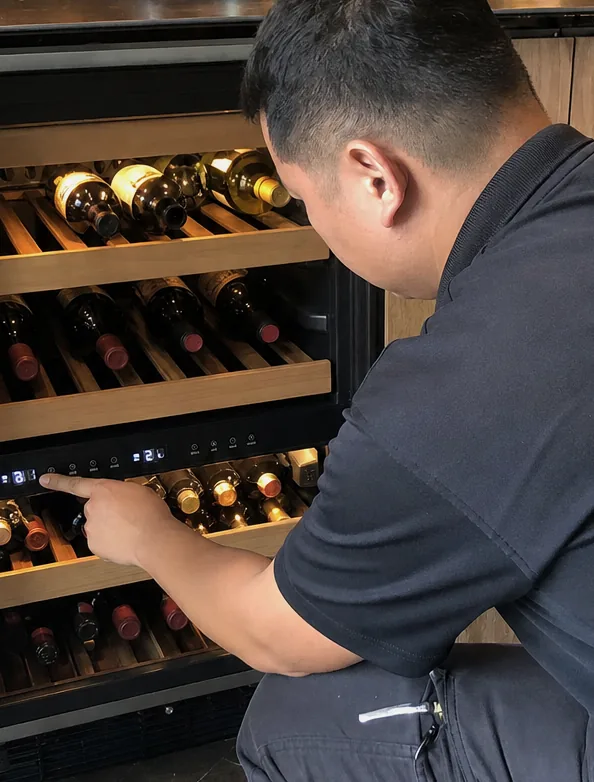
A built-in cabinet that is not running looks exactly like a built-in cabinet that is running badly, and the two are separated at the receptacle, not at the compressor. That is why this stage comes first, and why it takes ten minutes rather than an hour.
What gets checked, and in what order
Supply comes first: is there voltage at the outlet the unit is plugged into, and is the breaker that feeds it doing what it should. Built-in refrigeration is normally fed from a dedicated circuit, and the receptacle for it usually sits behind the cabinet or inside the surround, where nobody has looked at it since installation. It is also, frequently, the circuit somebody shared with an island outlet during a later renovation.
Then the control: does the display respond, does it respond consistently, and what happens through a full power cycle. A control that lights up and forgets its setpoint, a control that responds only intermittently, and a control that is completely dark are three different findings, not one.
Then history. When did it last work properly, and what happened between then and now. That question sounds like small talk. It is not.
Why the outage question matters here
Around 68 thunderstorm days a year cross this part of north-east Florida. The damage they do to appliances is not mechanical — a compressor is a fairly blunt object, and a nearby strike or a supply transient does not usually reach it. Control electronics are a different matter.
The pattern worth knowing is the delayed one. The multi-day outages that came with Matthew in 2016, Irma in 2017 and Helene in 2024 did not produce a wave of appliance failures the same week. They produced failures over the following weeks, in cabinets whose owners had long since stopped connecting the two events. A board that took a transient does not always stop; sometimes it starts behaving oddly, resets at random, or loses one function while keeping the rest.
So if a cabinet has gone strange since an outage, that belongs in the first two minutes of the phone call. It changes which stage we expect to find the answer at, and it changes what travels on the van.
What finishing this stage rules out
That a dark or unresponsive cabinet is a refrigeration fault. Quoting a control or supply problem as a sealed-system repair is the single most expensive mistake available on a first visit, and it happens because the technician started at the interesting end instead of the cheap one.
It also rules in something useful. If the unit powers up cleanly, holds its settings through a cycle, and drives its fans and lights as it should, then every later stage is being measured on a cabinet that is genuinely trying to work — which is the only condition under which those measurements mean anything.
What we ask you to have ready
The model and serial number from the rating plate. On built-in refrigeration that plate is inside the cabinet, usually on an upper side wall or behind the grille, and the serial number matters more than most people expect: it is what decides which version of a control or a valve actually fits. Two cabinets that look identical across a kitchen can take different parts.
If the serial is unreadable — and after fifteen years in a humid kitchen some are — say so. There are other ways to identify a cabinet, but they take time, and knowing in advance is the difference between one visit and two.
Scope
We work on Sub-Zero refrigeration only, and we are an independent company with no manufacturer affiliation. Where a fault sits inside a control that is still covered by the original manufacturer terms, we will tell you that rather than quote for it — there is nothing in it for us either way, and it is your money.
The diagnostic is $80 flat, credited toward the repair if you go ahead, with a written estimate before any part is ordered.
What does a repair found at this stage cost in Nocatee?
$80 flat to diagnose, credited toward the repair once you approve it. Completed work on this page has landed between $420 and $780, parts and labor together. The firm figure is written down after the diagnosis, not before it.
| Repair | Typical range |
|---|---|
| Diagnostic visit, credited toward the repair | $80 |
| Electronic control board | $420–$780 |
Ranges are what this work has cost, not a quote. A range moves with the part version the serial number calls for and with what the cabinet turns out to need. The whole table is on the pricing page.
How much does a repair found at this stage cost in Nocatee?
$80 flat to diagnose, credited toward the work. Completed repairs in this category have run $420 to $780, parts and labor together. The band your cabinet lands in is written into the estimate before anything is ordered.
Does the 50% rule apply to a built-in?
Rarely on a full-size cabinet. The dearest repair in the book, $2,270, is about 20% of the cheapest comparable replacement at $11,600, and panels and cabinetry sit on top of that figure. On a wine or undercounter unit it becomes a real test.
When is the cabinet not worth repairing?
When the part is discontinued, when the lead time is longer than you can live with, or when the figure is a large fraction of a replacement. A sealed-system repair runs $910–$2,270, and the estimate says plainly when that is the wrong side of the comparison.
$80 flat to diagnose, credited toward the repair if you go ahead with the work. 90 days on labor, 365 days on parts. Pricing · Warranty · Contact