Stage 2: Air, Condensers and Cabinet Clearance
The cheapest fault on the list and the most commonly missed — a cabinet that cannot reject its heat produces the entire symptom list of a failing compressor.
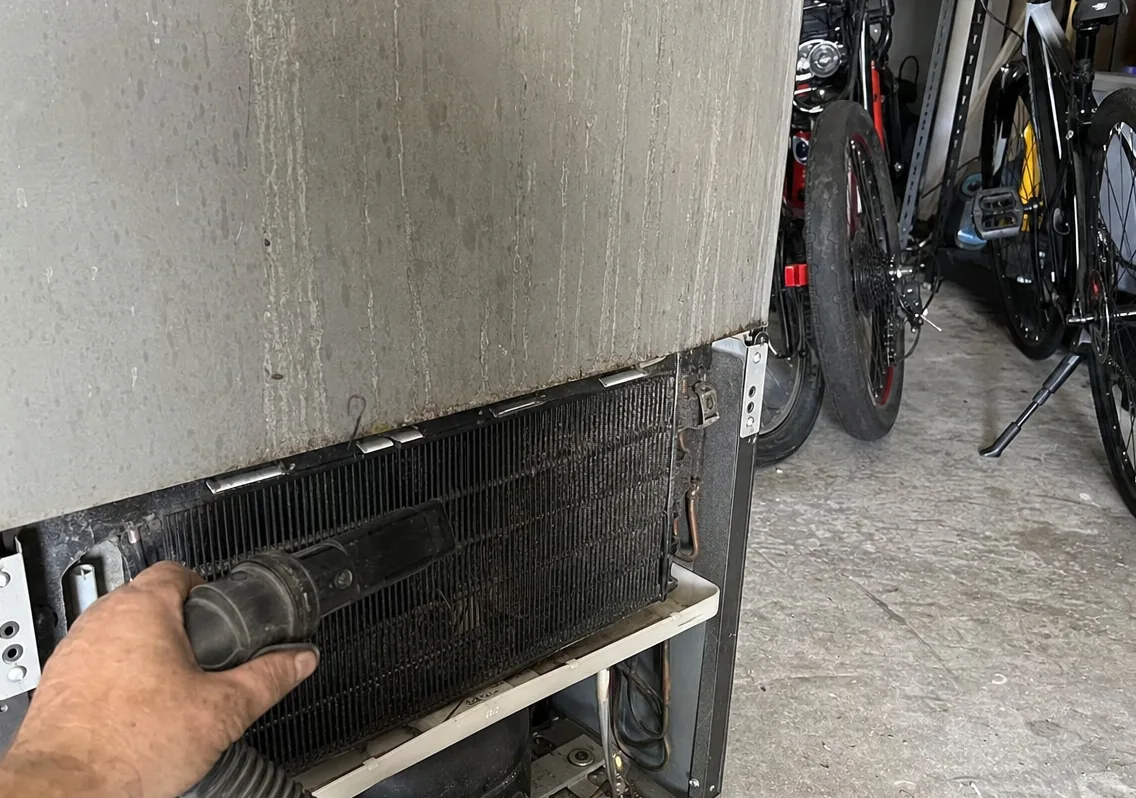
A refrigerator does not make cold. It moves heat out of a box and rejects it into the room, and everything about a built-in installation makes that harder than it is for a freestanding appliance. This stage is about whether the heat has anywhere to go.
The grille comes off before anything else
A built-in rejects its heat through a condenser behind a grille — at the top of the cabinet on a full-height unit, at the toe-kick on an undercounter one. Both are covered by joinery, and both collect exactly what a kitchen floor collects: dust, pet hair, and the fine grey felt that builds up on aluminium fins over a few years.
A coil in that condition adds head pressure to a system that is already working against Florida ambient heat for eight months of the year. What the owner experiences is long run times, poor recovery after the door has been open, a cabinet sitting a few degrees above setpoint through the summer, and more noise than there used to be. That is, word for word, the complaint list of a failing compressor — which is why it is worth ten minutes and a torch before anybody starts talking about sealed systems.
Clearance is part of the appliance
The second half of this stage is the opening the cabinet sits in. Built-in refrigeration is specified with clearances around it, and those clearances get consumed over time by things that had nothing to do with the appliance:
- A cabinet run refitted after the appliance was installed, with a filler panel that now sits over part of the grille.
- Crown or trim added above a full-height unit, closing the gap the top vent was drawing through.
- An undercounter unit in an island, venting into the stillest air in the room, with a dishwasher two cabinets away adding its own heat to the same pocket.
- Storage packed in behind or beside a unit that was installed with a service gap around it.
None of that is a fault in the appliance, and none of it can be fixed by replacing a part. It is also invisible from the front, which is why owners are often certain nothing has changed.
Coastal cabinets get a second look
Along the ocean — 32082, 32250, 32233 — salt-laden air adds a corrosion load that inland cabinets do not carry. Aluminium condenser fins lose surface area to it, which reduces heat rejection just as effectively as a coil packed with dust, and it does so on a coil that can look clean from a distance. Exterior stainless pitting is cosmetic, but it is a reliable indicator of how hard the air is working on everything else in the cabinet. Nocatee is inland and does not carry that load; there is no reason to price it into a 32081 job.
What finishing this stage rules out
That a warm cabinet with a long duty cycle is a refrigeration fault. It usually is not. It also rules out any later reading being misinterpreted, because a sealed-system measurement taken behind a restricted condenser is not wrong so much as meaningless — the system is doing what a healthy system does when it is asked to reject heat into a blanket.
The one thing an owner can influence
This is the only stage of the six where the householder can genuinely change the outcome. A condenser cleaned on a sensible interval buys years on a compressor, and the interval that suits a kitchen with two dogs is not the interval that suits a kitchen with none. We will show you the grille, show you what the coil looks like now, and tell you the interval we would use — not sell you a subscription.
The diagnostic is $80 flat, credited toward the repair if you go ahead, with a written estimate before any part is ordered. We are an independent company servicing Sub-Zero refrigeration only.
What does a repair found at this stage cost in Nocatee?
$80 flat to diagnose, credited toward the repair once you approve it. Completed work on this page has landed between $260 and $2,270, parts and labor together. The firm figure is written down after the diagnosis, not before it.
| Repair | Typical range |
|---|---|
| Diagnostic visit, credited toward the repair | $80 |
| Compressor or sealed-system repair | $910–$2,270 |
| Evaporator or condenser fan motor | $260–$570 |
Ranges are what this work has cost, not a quote. A range moves with the part version the serial number calls for and with what the cabinet turns out to need. The whole table is on the pricing page.
How much does a repair found at this stage cost in Nocatee?
$80 flat to diagnose, credited toward the work. Completed repairs in this category have run $260 to $2,270, parts and labor together. The band your cabinet lands in is written into the estimate before anything is ordered.
Do you charge more for a harder-to-reach cabinet?
No. The $80 is the same whether the unit is a column behind flush panels, an undercounter drawer under a counter run or a wine cabinet in a butler pantry, and the same anywhere inside St. Johns County.
Do you work on anything other than this brand?
No. Sub-Zero refrigeration only, and that is a deliberate limit. One line of equipment means the parts on the van match the appliance in the opening and the service positions are already known. We turn other work down.
$80 flat to diagnose, credited toward the repair if you go ahead with the work. 90 days on labor, 365 days on parts. Pricing · Warranty · Contact