Stage 3: Doors, Gaskets and Panel Weight
A door that has stopped pulling flush over its last inch produces frost, condensation and an endless duty cycle — and it is an adjustment, not a repair.
The most expensive misdiagnosis in this trade is a door fault written up as a refrigeration fault. The symptoms overlap almost completely, the door is the cheapest thing in the cabinet to put right, and it takes a straightedge and five minutes to settle. So it gets settled before stage four, not after it.
What a failing seal actually looks like
Not a gap you can see. By the time a gasket is visibly standing off the cabinet face, it has been leaking for a long time. The usual presentation is a door that no longer pulls itself flush over the final inch of travel, so it sits closed but not sealed, and the leak is at one top corner where the geometry is worst.
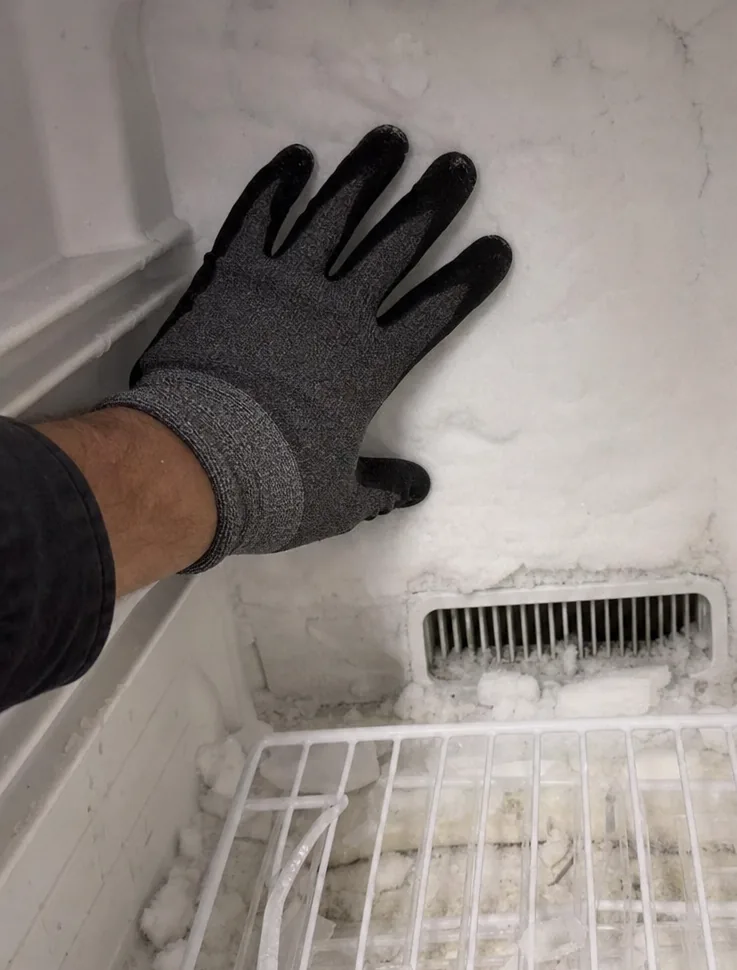
From there the sequence is predictable. Humid room air enters at that corner — and in a Florida kitchen there is a great deal of moisture in it. The compartment works harder to hold setpoint, so the duty cycle rises. Moisture condenses and freezes where the cold surfaces are, so frost appears on the back wall of a freezer, or condensation forms along the edge of a custom panel. The owner reports the frost, which is three steps downstream of the cause.
An ajar alarm sounding at night, with the door apparently shut, is the same fault announcing itself: the cabinet contracts as it cools, the marginal seal opens, and the alarm is correct.
Panels change the mechanics
An integrated column or a panelled undercounter door is not the door the hinge was balanced for. A custom panel adds real mass, hung forward of the hinge line, and everything downstream of that mass carries the load on every swing — the hinge cartridge, the closer, and the fixings holding the panel to the door frame.
That is why alignment work is a much larger share of column calls than most owners expect, and why the fix is often a hinge or closer adjustment and a panel refixing rather than a part. New joinery settles too; a house a year old can present exactly this fault for entirely benign reasons.
What we do
A straightedge goes across the door and the cabinet face, so the geometry is measured rather than eyeballed. Seal contact is checked along the whole length of the gasket rather than at the handle, because the handle side is the side that always feels right. Hinge cartridge and closer travel are checked over the last inch of the swing, which is the inch that matters. On a panelled door, the panel fixings and the panel weight get their own look.
Where a gasket has taken a set — compressed flat, or hardened at a corner — it is replaced. Where the geometry has moved, it is adjusted. The estimate says which of the two we are proposing, and why.
What finishing this stage rules out
That frost on a freezer wall, condensation at a panel edge or a compressor that never seems to cycle off is a refrigeration problem. Often it is a door problem wearing a refrigeration costume, and treating it as the latter means paying several hundred dollars to leave the actual fault in place.
It also protects the next stage. Temperature and defrost readings taken on a cabinet that is drawing humid room air through a corner will describe the leak, not the refrigeration — and they will describe it in a way that looks convincingly like a defrost fault.
Terms
The diagnostic is $80 flat, credited toward the repair if you go ahead. You get a written estimate before any part is ordered and before any work begins. Where the finding is an adjustment rather than a repair, that is what the report will say, and there will be nothing to sell.
We are an independent repair company and we service Sub-Zero refrigeration only. Repairs carry 90 days on labor and 365 days on parts, with genuine OEM parts fitted.
What does a repair found at this stage cost in Nocatee?
$80 flat to diagnose, credited toward the repair once you approve it. Completed work on this page has landed between $250 and $780, parts and labor together. The firm figure is written down after the diagnosis, not before it.
| Repair | Typical range |
|---|---|
| Diagnostic visit, credited toward the repair | $80 |
| Door gasket or seal replacement | $250–$590 |
| Defrost heater, thermostat or sensor | $250–$590 |
| Electronic control board | $420–$780 |
Ranges are what this work has cost, not a quote. A range moves with the part version the serial number calls for and with what the cabinet turns out to need. The whole table is on the pricing page.
How much does a repair found at this stage cost in Nocatee?
$80 flat to diagnose, credited toward the work. Completed repairs in this category have run $250 to $780, parts and labor together. The band your cabinet lands in is written into the estimate before anything is ordered.
Is the $80 charged on top of the repair?
No. Credited toward the repair if you go ahead with the work. It covers the visit and all 6 stages, whichever stage the fault turns out to sit at, and there is no separate call-out charge and no hourly rate running beside it.
Which repair on this list is the expensive one?
The sealed system, at $910–$2,270 against $250–$590 for a door gasket. It is measured last for exactly that reason: the five cheaper stages can each make a healthy circuit read badly, and most of what they find is an adjustment rather than a part.
$80 flat to diagnose, credited toward the repair if you go ahead with the work. 90 days on labor, 365 days on parts. Pricing · Warranty · Contact