Stage 4: Temperature, Frost and Defrost
What the cabinet is actually holding, measured over the visit rather than read once — and what the frost pattern on an evaporator is telling you.
By this stage the cabinet has power, it can reject its heat, and its doors are sealing. Only now does a temperature reading mean anything, because only now is it describing the refrigeration rather than describing the conditions the refrigeration was asked to work in.
One reading is not a measurement
A display shows a setpoint and, usually, an approximation of what the cabinet is holding. Neither tells you how the cabinet behaves over an hour, and behaviour over an hour is the diagnosis.
So compartment air gets logged across the visit: what it holds, how far it drifts, how quickly it recovers after the door has been open, and whether the freezer and fresh-food sides move together or independently. That last point matters more on this equipment than on most, because built-ins and paired columns run separate refrigeration circuits for the two compartments. A freezer holding at setpoint while the fresh-food side climbs is not a mystery — it says which of the two circuits to look at, and it says that an estimate for one circuit is not an estimate for the cabinet.
The corollary trips people up. Two independent circuits do not usually fail on the same afternoon, so when both compartments are warm at once, the first thing to suspect is not two simultaneous faults but something they share: power, control, or a condenser choked for both. That is a stage-one or stage-two answer, arrived at from a stage-four observation.
The frost pattern is a diagram
An evaporator carries a pattern of frost, and the pattern is readable.
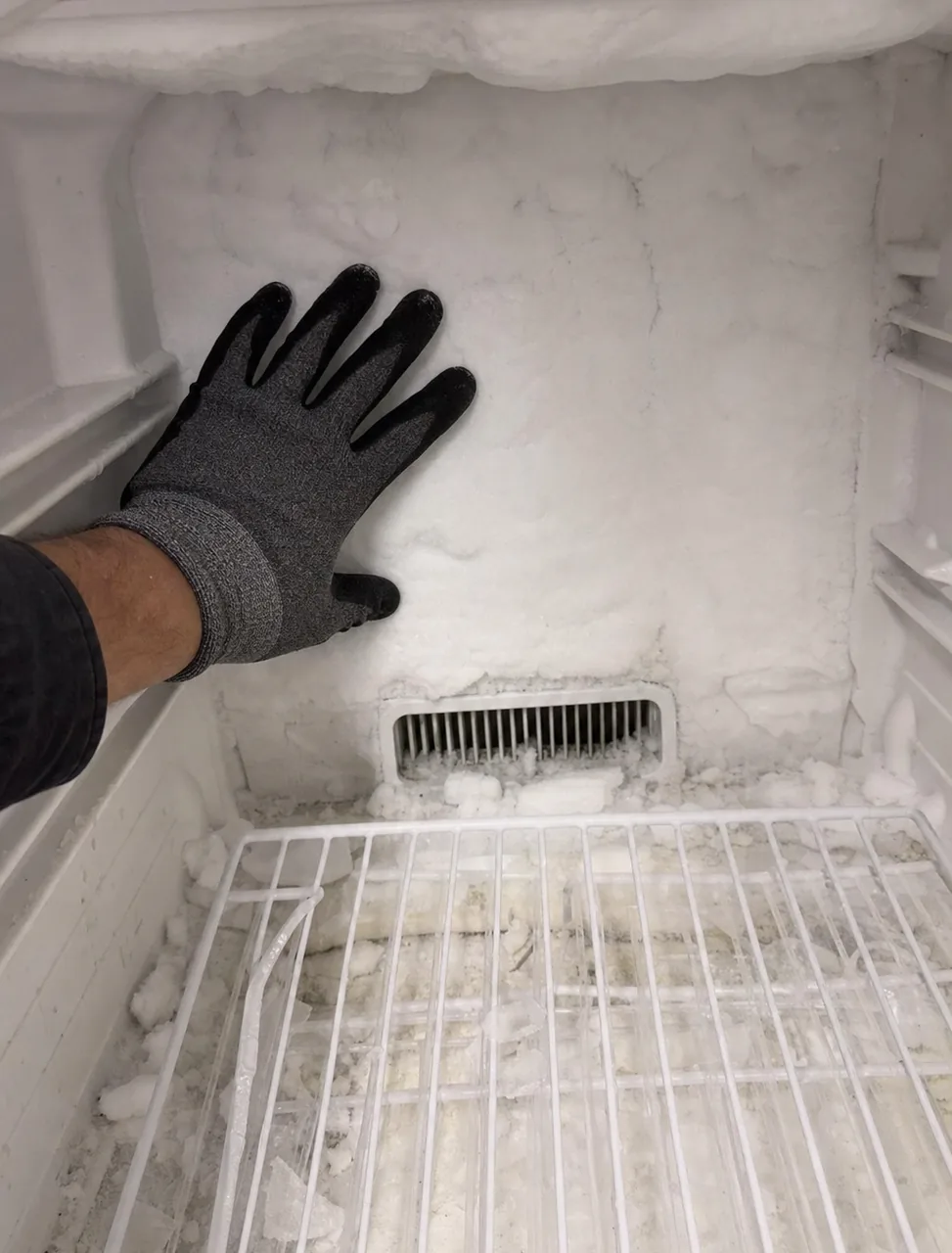
Uniform, heavy frost across the whole coil, on a cabinet that recovers properly once it has been emptied and left open to thaw, is usually a defrost problem — a heater, a sensor, or a control that has stopped running the cycle. The refrigeration is working; it is being buried.
Frost on one section with clear metal on the rest is a different animal entirely. That is a charge or restriction pattern: the coil is only cold where there is refrigerant doing work, which points at stage six rather than at a defrost component. The two faults present to the owner in almost the same way and cost very different amounts of money, and the only thing that separates them reliably is looking at the coil and waiting out a cycle.
Fan behaviour gets checked alongside it. An evaporator fan that has stopped, or that runs when it should not, redistributes cold in ways that produce warm shelves and frozen produce in the same compartment — a complaint that sounds like a control fault and often is not.
Patience is part of the method
This is the stage that takes time, and it is the reason a thorough diagnostic is not a fifteen-minute visit. Cycles take as long as they take. A technician who does not wait for one has to guess at what happens during it, and guessing at this stage is what produces a replaced part and an unchanged symptom.
What finishing this stage rules out
Defrost, fan and airflow faults, and the whole family of complaints where the cabinet is genuinely cold but the cold is in the wrong place. It also identifies which sealed system, on a dual-circuit cabinet, stage six should be measuring — because measuring the wrong one produces perfectly good readings and a wrong answer.
Terms
The diagnostic is $80 flat, credited toward the repair if you go ahead, and it buys measurement rather than opinion. You get a written estimate before any part is ordered and before any work begins.
We are an independent repair company servicing Sub-Zero refrigeration only. Completed repairs carry 90 days on labor and 365 days on parts, with genuine OEM parts fitted.
What does a repair found at this stage cost in Nocatee?
$80 flat to diagnose, credited toward the repair once you approve it. Completed work on this page has landed between $250 and $590, parts and labor together. The firm figure is written down after the diagnosis, not before it.
| Repair | Typical range |
|---|---|
| Diagnostic visit, credited toward the repair | $80 |
| Defrost heater, thermostat or sensor | $250–$590 |
| Evaporator or condenser fan motor | $260–$570 |
Ranges are what this work has cost, not a quote. A range moves with the part version the serial number calls for and with what the cabinet turns out to need. The whole table is on the pricing page.
How much does a repair found at this stage cost in Nocatee?
$80 flat to diagnose, credited toward the work. Completed repairs in this category have run $250 to $590, parts and labor together. The band your cabinet lands in is written into the estimate before anything is ordered.
Why is a range published instead of a price?
Because the serial number decides which version of a part fits, and the cabinet decides how much of it has to come apart. Written estimate before any repair begins. No work starts without your approval. The range tells you whether to book the visit; the estimate tells you what to approve.
Do you charge more for a harder-to-reach cabinet?
No. The $80 is the same whether the unit is a column behind flush panels, an undercounter drawer under a counter run or a wine cabinet in a butler pantry, and the same anywhere inside St. Johns County.
$80 flat to diagnose, credited toward the repair if you go ahead with the work. 90 days on labor, 365 days on parts. Pricing · Warranty · Contact