Sub-Zero Ice Maker Making Small Hollow Cubes
Cube size is a symptom, not a diagnosis. Fill volume is measured with a vessel and a stopwatch, and the freezer compartment is checked before any valve is quoted.
An ice maker rarely dies. It degrades, and it does so in a fixed order that is worth knowing, because catching it at stage one costs a fraction of catching it at stage four.
Read the cube, not the machine
- The cube gets smaller. A fill valve meters by time, not by volume. It opens for a fixed interval and passes whatever the pressure and the orifice allow, then closes whether the mold is full or not. Anything that restricts flow upstream of it leaves the mold underfilled. Nothing has failed yet.
- The cube gets hollow. Underfilled molds freeze from the outside in and never complete. Cubes come out thin-walled and shatter in the glass.
- The harvest starts repeating. When ice stops releasing cleanly, the harvest cycle runs again, and the unit spends its day trying to let go of ice instead of making more.
- Output collapses. The owner finally calls, usually in July, usually with guests arriving.
One local factor belongs in that story, stated once. JEA publishes a tap-water hardness of 372 parts per million for 32081, and dissolved calcium and magnesium leave deposit on a valve seat and a mold surface over time rather than passing through. That is a reason to measure the fill on an older machine here, not a reason to assume it: plenty of small-cube calls in this ZIP turn out to be a restricted cartridge or a warm compartment instead.
What we actually check
The $80 diagnostic on an ice maker is a set of measurements. We take a timed fill into a graduated vessel, so we know what the valve is passing rather than inferring it from cube size. We take dispensed volume over a timed run and compare the two, because if ice and water weaken together the restriction is upstream of the point where the line splits, and if only one side weakens it is downstream — a comparison that halves the investigation before a part is touched. We check the filter on what it is passing now rather than on its date. We check the supply shutoff and the line behind the cabinet. And we inspect the valve seat, the mold surface and the harvest mechanism itself.
The impostor worth ruling out
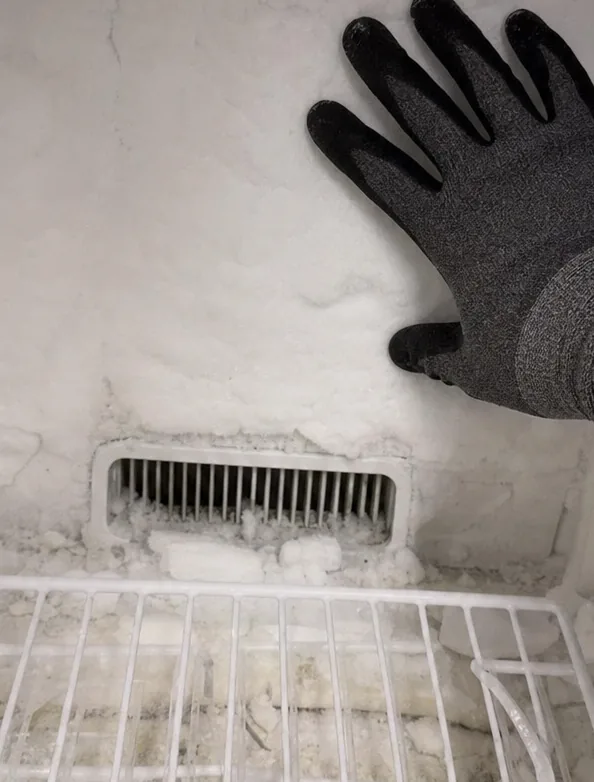
A freezer compartment running a few degrees warm produces small, cloudy, poorly formed ice and a slow harvest — the same complaint list as a restricted fill, from an entirely different cause. It is one of the most common confusions in this trade, and it is why compartment temperature is logged before the water side is measured rather than after. We would much rather tell you the compartment is running warm than sell you a valve.
Ice maker not making ice at all
A machine producing nothing is a different investigation from one producing poor ice, and one question splits it in three. Can you hear water arriving?
If water fills and no ice forms, the fill side is working and the freezing side is not: compartment temperature, air return at the mold, or a harvest that never completes. Stage 4 answers that before anything on the water side is touched. If nothing arrives at all, the fault is upstream — the shutoff behind the cabinet, the cartridge, the line or the valve — and stage 5 measures a timed fill into a vessel rather than inferring it. If ice forms and then stays in the mold, the harvest mechanism is the subject and the water side is innocent.
The bin arm sits across all three and costs nothing to rule out. On most cabinets the machine stops deliberately while the arm is held up, and an arm resting on a block of fused ice reads to it as a full bin. Clear the bin, let the arm swing, and give it a cycle before you book anything.
Whichever of the three it turns out to be, the repair it leads to is the ice maker, water valve and supply line row of the table below, or the defrost heater and sensor row — not the sealed system, which is the most expensive thing on this cabinet and has nothing to do with cube production.
Cleaning versus replacing
Where the components are otherwise sound, cleaning the mold and the seat can restore output with no new parts at all. Where a valve has been throttling for years it often will not seal cleanly again once it is disturbed, and it is replaced with a genuine OEM part — chosen against the serial number, because component revisions do not stop for model-name changes and two machines that look identical can take different valves. The estimate says which of the two we are proposing and why, in writing, before anything is ordered.
The preventative measure that actually works
Change the cartridge by flow, not by calendar. A filter is rated in gallons and the month figure on the box is an estimate of how long an average household takes to reach that figure; what matters is what it is passing today. A restricted cartridge starves the fill valve in exactly the way anything else upstream does, producing the same small hollow cubes from a cause that costs a filter rather than a service call. If your cubes have changed shape in the last three months, that is the first thing to rule out, and you can rule it out yourself.
Standing units and seasonal use
A bar or cabana machine used in bursts behaves differently from a kitchen unit run daily. Water left standing in a fill line evaporates slowly at the mold, so a unit run three weekends a month can look worse after two years than a daily one does after five. If you shut a unit down for the summer, shut off the supply, run the mold empty and clear the bin — old ice sublimates, fuses into a block, and is the usual reason a harvest stalls on the first cycle after a return.
Repairs carry 90 days on labor and 365 days on parts. We are an independent company servicing Sub-Zero refrigeration only, and our technicians hold EPA Section 608 certification for sealed-system work.
What does ice makers work cost in Nocatee?
$80 flat to diagnose, credited toward the repair once you approve it. Completed work on this page has landed between $240 and $2,270, parts and labor together. The firm figure is written down after the diagnosis, not before it.
| Repair | Typical range |
|---|---|
| Diagnostic visit, credited toward the repair | $80 |
| Ice maker, water valve or supply line | $240–$650 |
| Compressor or sealed-system repair | $910–$2,270 |
Ranges are what this work has cost, not a quote. A range moves with the part version the serial number calls for and with what the cabinet turns out to need. The whole table is on the pricing page.
How much does ice makers work cost in Nocatee?
$80 flat to diagnose, credited toward the work. Completed repairs in this category have run $240 to $2,270, parts and labor together. The band your cabinet lands in is written into the estimate before anything is ordered.
When is the cabinet not worth repairing?
When the part is discontinued, when the lead time is longer than you can live with, or when the figure is a large fraction of a replacement. A sealed-system repair runs $910–$2,270, and the estimate says plainly when that is the wrong side of the comparison.
Is the $80 charged on top of the repair?
No. Credited toward the repair if you go ahead with the work. It covers the visit and all 6 stages, whichever stage the fault turns out to sit at, and there is no separate call-out charge and no hourly rate running beside it.
$80 flat to diagnose, credited toward the repair if you go ahead with the work. 90 days on labor, 365 days on parts. Pricing · Warranty · Contact
Calls about ice makers, as owners described them
Three of the Sub-Zero owners who called us, picked because the call was about this equipment.
4.64.6 out of 5 — the mean of all 60 reviews collected after a visit
4 out of 5
Output had been falling all season and I assumed the whole assembly was gone. It was the fill valve plus a cartridge long past its rated gallons. Two visits because the valve had to be ordered, but the ice is right again.
Delia K.July 2025
4 out of 5
The second ice maker in our pantry was making cubes but never dropping them. The ejector arm had jammed against a slab of frost from a leaking bin seal. He cleared it, changed the seal, and stayed to watch two cycles finish.
Luis C.August 2026
3 out of 5
The ice maker works properly now and the price matched the estimate. What lost a couple of stars was the scheduling: the first slot was rearranged twice before anyone actually arrived at the house.
Desmond K.April 2026